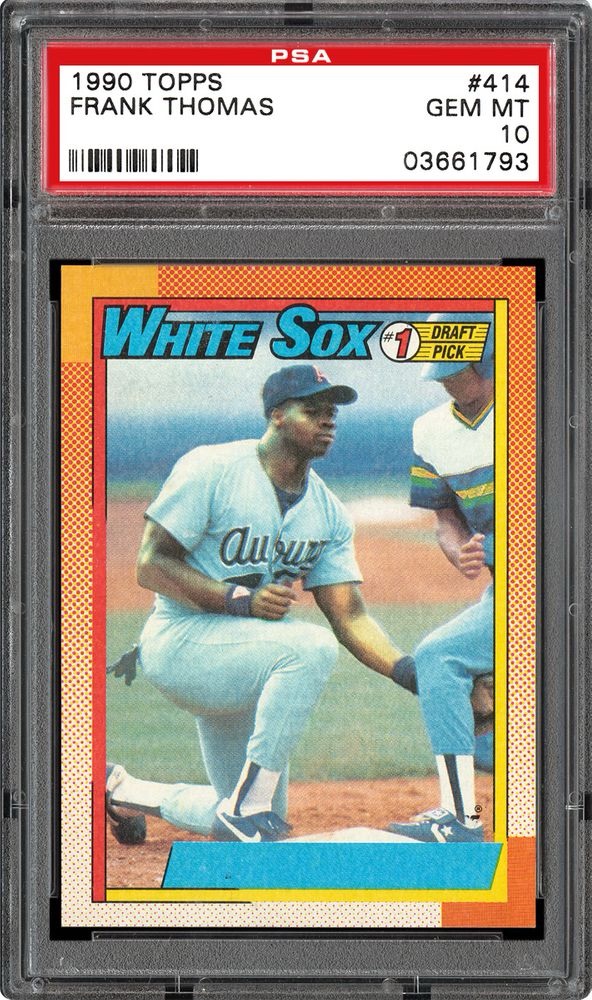
Baseball cards have always been prized by collectors, but some of the most valuable ones aren’t flawless—they’re the ones with mistakes. Take the 1990 Topps Frank Thomas rookie card, for example. In its standard form, it’s worth $20 to $40 depending on condition. But an error version, known as the “No Name on Front” (NNOF), is extremely rare and has sold for as much as $3,800 in high-grade condition.
Why does the error make it more valuable? Because rarity drives demand, and what might have been seen as a misprint became a collector’s treasure.
What if we applied that same principle to our lives?
There’s an incredible truth in Romans 8:28: “And we know that all things work together for good to them that love God, to them who are the called according to his purpose.” Not just the good things—but all things, including our mistakes and missteps, can be used for a greater purpose.
We all make mistakes. Maybe you’ve failed, stumbled, or fallen short. It’s easy to want to tuck those moments away, to bury them like a flawed card at the bottom of a collection. But what if, instead, we embraced them? What if we looked at our flaws and errors as rare opportunities to learn, grow, and create something of unique value?
The Apostle Paul understood this. In Philippians 3:8, he said he counted all his mistakes and accomplishments alike as “dung”—not waste to be discarded, but fertilizer to nourish his future. He turned his misprints into a testimony that shaped his calling and impacted countless lives.
There’s a famous quote often attributed to Winston Churchill: “Never let a good crisis go to waste.” A crisis or a mistake might feel like the end, but it can also be the beginning of something extraordinary. Every error presents an opportunity to innovate, grow, and find meaning in what might otherwise seem like failure.
Whoever decided that error cards could be marketed as more valuable wasn’t trying to erase the mistakes—they embraced them. They saw potential where others saw flaws. That perspective is a game-changer, and it’s one we can adopt in our own lives.
Your errors and missteps are part of your unique story. They don’t define you, but they can refine you. Instead of hiding them, use them to build something that lasts. Take every failure, every crisis, and every flaw, and find the value hidden within.
The rarest treasures are often found in the imperfections. So whatever you’re facing—whatever mistakes you’ve made—don’t let them go to waste. Learn from them. Grow from them. And most importantly, make them count.
Because in the end, it’s not about perfection. It’s about purpose. And when you see your life through that lens, every moment, every misstep, and every misprint becomes an opportunity to make it count.
 Make it Count
Leave a comment